INTRO
A landscape-grade Medjool is one of the most resilient feature trees you can specify — but resilient is not invincible. Most palm failures we see in the field trace back to three preventable causes: a wound that let a pathogen in, water managed wrong, or a deficiency left uncorrected for seasons. This page is our field reference — every disease, pest, and physiological problem worth knowing on Phoenix dactylifera, with symptoms, causes, and the industry-standard remedy for each. It is the same standard we hold our own groves to.
FUNGAL & PATHOGENIC DISEASES
Ganoderma Butt Rot (Ganoderma zonatum)
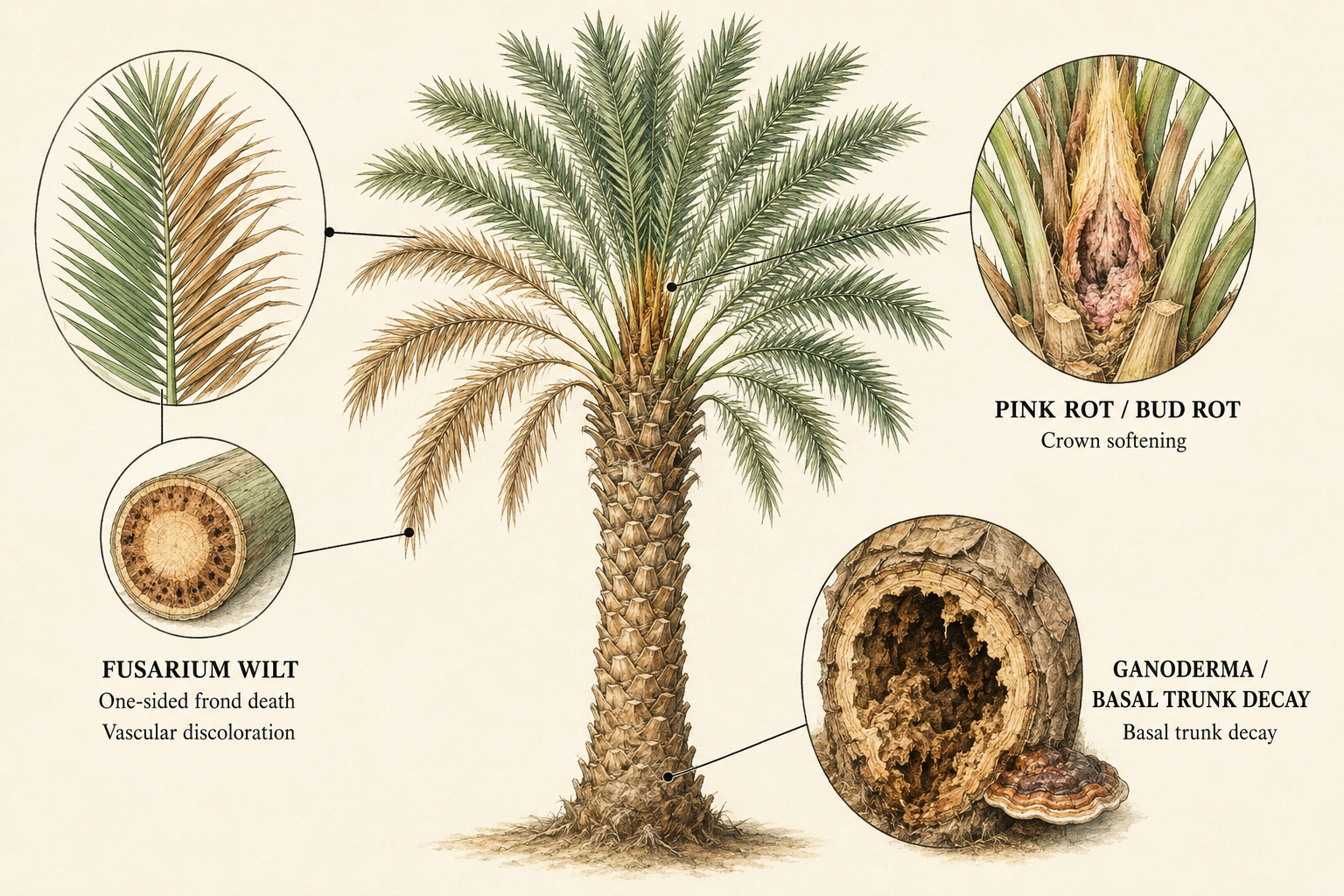
What it is. A soil-borne fungus that degrades the lower 4–5 feet of the trunk from the inside. The most serious palm disease in the southeastern U.S. Symptoms. Wilting and drooping of older fronds, stunted pale new growth, a hollow sound when the lower trunk is tapped — and, definitively, a hard shelf-like conk (bracket fungus) emerging at the trunk base. Treatment. There is no chemical control. An infected palm cannot be saved and becomes a structural hazard as the trunk loses strength. Industry standard: remove the palm promptly, including as much of the stump and root system as practical, and do not replant a palm in the same spot — the fungus persists in soil. Prevention. Ganoderma enters through wounds at the trunk base. Keep string trimmers and mowers away from the trunk, never wound the lower trunk during planting or maintenance, and inspect the base of established palms annually for conks.
Thielaviopsis Trunk Rot (Thielaviopsis paradoxa)
What it is. A wound pathogen that causes "stem bleeding" and internal trunk collapse. Symptoms. A dark, wet, bleeding lesion on the trunk; in advanced cases the trunk softens and the canopy falls without warning. Treatment. No cure once established in the trunk. Palms with significant trunk rot must be removed for safety. Prevention. This disease is almost entirely preventable: the fungus can only enter through fresh wounds. Never use climbing spikes on a palm, sterilize pruning tools between trees (a 10-minute soak in 1:3 bleach solution or wiping with 70%+ alcohol), avoid pruning in wet weather, and never cut into the trunk.
Bud (Heart) Rot (Phytophthora and others)
What it is. Rot of the single growing point (terminal bud). Because a palm has only one bud, this is life-or-death. Symptoms. The newest spear leaf turns black, pulls out easily, and smells of rot; older fronds stay green for months while the heart is already dead. Treatment. Caught at the earliest stage, remove the rotted spear material and treat the bud zone with a copper-based fungicide; keep the crown dry. If the bud is fully rotted, the palm will not recover. Prevention. Most common after cold damage, crown injury, or prolonged crown wetness. Avoid overhead irrigation that wets the crown, apply preventive copper fungicide to the crown after a hard freeze or storm damage, and maintain the protective frond count over the bud.
Graphiola Leaf Spot / False Smut (Graphiola phoenicis)
What it is. The most common cosmetic disease on date palms in humid climates — very familiar in Florida and Gulf Coast installations. Symptoms. Small black wart-like bodies erupting through both leaf surfaces on older fronds. Treatment. Rarely threatens the palm. Remove only the most heavily spotted fronds — never strip green fronds, which does more harm than the fungus. Copper fungicide applied preventively in spring protects new growth where appearance matters. Prevention. Air movement and dry foliage. Space palms properly at design time, and never irrigate the canopy.
Fusarium / Bayoud — a sourcing note
Bayoud disease (Fusarium oxysporum f. sp. albedinis), the date palm's most feared disease worldwide, does not occur in the United States — one more reason provenance matters. Fusarium decline seen on Phoenix in American landscapes primarily affects Canary Island date palms, and is spread overwhelmingly by unsterilized pruning tools. The remedy is the same discipline as Thielaviopsis: clean tools, every tree, every time — and buy from groves with documented health, not brokered trees of unknown history.
PESTS
South American Palm Weevil (Rhynchophorus palmarum)
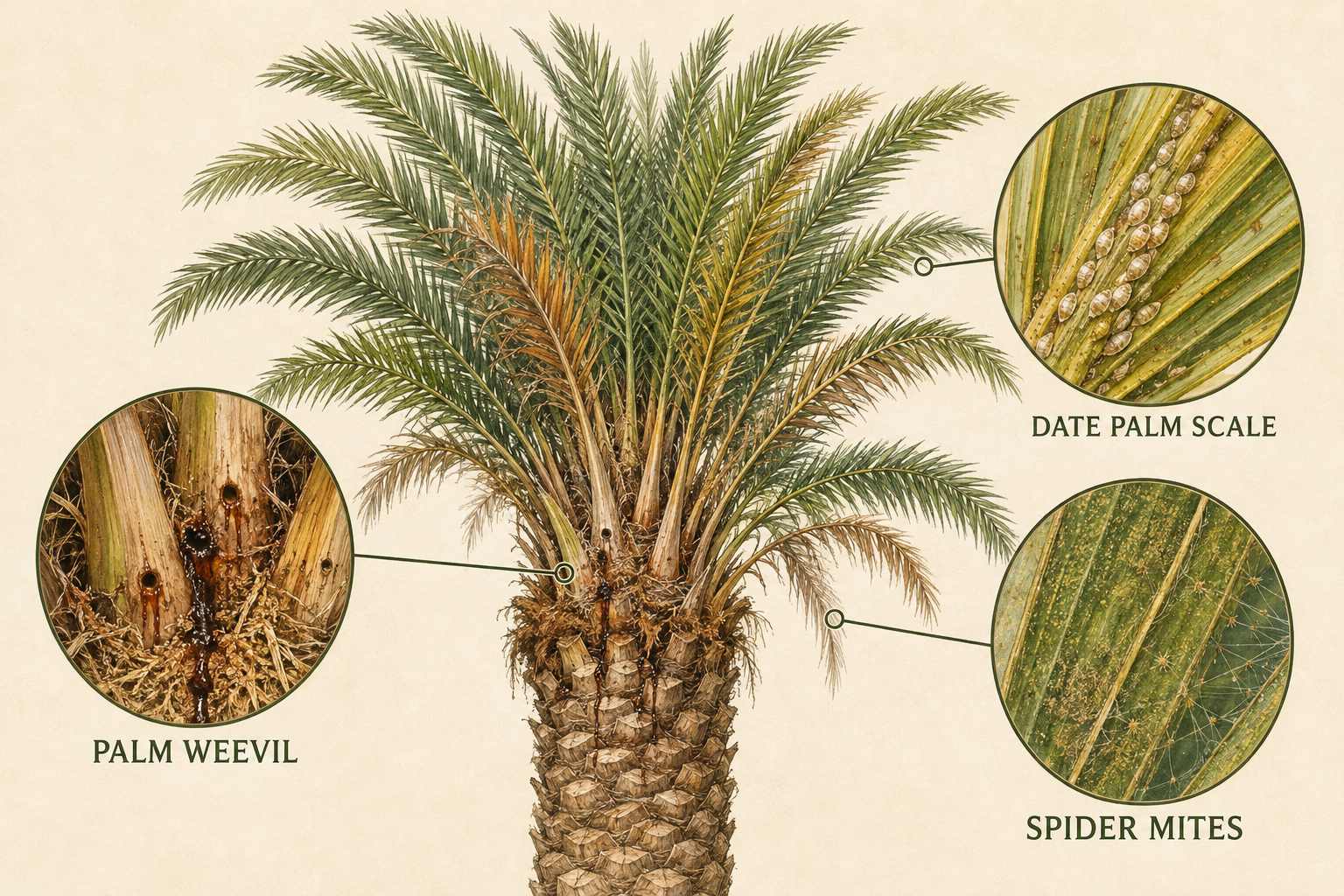
What it is. A large black weevil, established in parts of Southern California, whose larvae tunnel into the palm heart. The most serious insect threat to date palms in the western U.S. Symptoms. Drooping or collapsed new growth, a flattened or tilted crown, chewed frond bases, larval tunnels and fermented odor in the crown. Damage is often fatal by the time it is visible. Treatment. Early infestations are sometimes stopped with systemic insecticides (imidacloprid or acephate applications per label and local regulation) plus removal of infested tissue; heavily infested palms should be removed and destroyed — chipped or tarped — so the brood cannot mature and spread. Prevention. Weevils are drawn to the scent of fresh palm wounds. Time pruning outside peak flight periods, seal or minimize large cuts, use pheromone traps for monitoring in known weevil areas, and inspect crowns during routine maintenance. Note: the red palm weevil (R. ferrugineus), the global scourge of date palms, was detected in California in 2010 and declared eradicated — vigilance and clean sourcing keep it that way.
Scale Insects (red date scale, Parlatoria scale)
Symptoms. Encrusted gray-white or reddish bumps on fronds and fruit stalks; heavy infestations yellow the foliage. Treatment. Horticultural oil sprays smother scale without harming beneficials; systemic insecticides for severe cases. Natural predators usually keep scale in check on healthy palms. Prevention. Inspect incoming plant material — scale travels on nursery stock. Our palms ship from open desert groves where scale pressure is naturally low.
Spider Mites (Oligonychus spp.)
Symptoms. Fine stippling and a dusty, bronzed look on fronds, webbing in severe cases; worst in hot, dry, dusty conditions. Treatment. A strong water rinse of the canopy, miticides only for severe persistent infestations. Prevention. Healthy irrigation. Drought-stressed palms are mite magnets.
PHYSIOLOGICAL & NUTRITIONAL PROBLEMS
Potassium (K) Deficiency — the most common palm problem in the Southeast
Symptoms. Oldest fronds show yellow-orange translucent spotting, then withered, scorched tips while newer growth stays green. Remedy. Slow-release sulfur-coated potassium sulfate applied with magnesium (to prevent inducing an Mg deficiency). Never remove the discolored fronds — the palm is actively salvaging potassium from them, and stripping them accelerates the deficiency. Standard. Fertilize palms on their own program — not with turf fertilizer. The university-backed standard is an 8-2-12 +4Mg palm-special analysis with micronutrients, applied 3–4 times through the growing season.
Manganese (Mn) Deficiency — "frizzle top"
Symptoms. Newest fronds emerge weak, yellowed, with necrotic streaks and a frizzled, scorched look. Untreated, it kills the palm — the bud starves. Remedy. Manganese sulfate to the soil (or foliar for fast response) 2–3 times per year until corrected. Check soil pH — high-pH soils lock out manganese. Prevention. Avoid planting too deep (a leading cause) and avoid composted-manure mulches against the root zone.
Magnesium (Mg) Deficiency
Symptoms. Broad lemon-yellow bands along the margins of older fronds with a green center stripe. Cosmetic, but it announces a neglected fertility program. Remedy. Magnesium sulfate applications alongside the regular K program.
Iron (Fe) Deficiency
Symptoms. Interveinal yellowing on the newest fronds, usually on waterlogged or too-deeply planted palms rather than genuinely iron-poor soil. Remedy. Fix the cause: improve drainage, verify planting depth. Chelated iron helps cosmetically while the root zone recovers.
Overwatering, Poor Drainage & Planting Too Deep
The silent killers. Symptoms mimic disease: general decline, chlorosis, root rot, Mn lockout. The remedies are built into our installation spec — root-initiation zone at grade, never bury the trunk, confirm drainage before the first irrigation, water deeply and infrequently once established.
Cold Damage
A mature Medjool shrugs off cold into the mid-teens °F, but a hard freeze can damage the spear and open the door to bud rot. Standard response. After a damaging freeze: do not strip damaged fronds immediately (they insulate and feed recovery), apply a copper fungicide to the crown as bud-rot insurance, delay fertilization until new growth resumes, and assess the spear leaf at 60–90 days.
THE INDUSTRY-STANDARD PRACTICES, SUMMARIZED
- Sanitation is non-negotiable. Sterilize pruning tools between every palm. No climbing spikes, ever. No trunk wounds, ever.
- Prune conservatively. Remove only dead and fully browned fronds. Over-pruning ("hurricane cuts") starves the palm, concentrates nutrients loss, and attracts weevils.
- Feed palms like palms. 8-2-12 +4Mg palm-special fertilizer with micronutrients, 3–4 applications across the growing season. Keep turf fertilizer off the root zone.
- Water the roots, never the crown. Deep, infrequent irrigation; dry foliage; confirmed drainage.
- Inspect on a schedule. Trunk base for conks, crown for weevil sign, spear leaf for firmness, oldest fronds for K status — a five-minute annual inspection catches nearly everything early.
- Source clean. Most imported problems arrive on the truck. Specimens from documented, inspected groves — selected, harvested, and handled to spec — start the clock healthy.
Questions about a palm already in the ground, or specifying preventive care into a new installation?
Talk to us — palm health is part of every MedjoolPalm delivery, not an afterthought.